I-70 Billboards and Other Spiritual Awakenings: Madelyn Garner on her new book, The Luminous Between, published by 3: A Taos Press
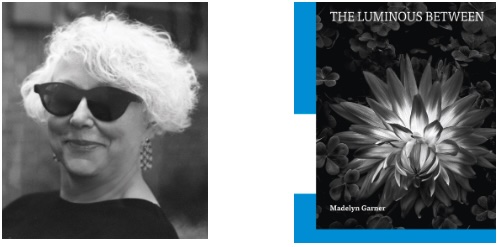
KW: Congratulations, Madelyn, on the publication of The Luminous Between with 3: A Taos Press. It’s a beautiful book, so let’s get to it. You’ve written The Luminous Between in the tradition of sacred poetry, of the spiritual quest to find what I’m going to call the “visceral presence” of God within our finite human realm of understanding versus the liturgic knowledge of God that the conventional religious service might service. The first poem of your book, which belies the praise convention of a topographical poem, is “The Storefront Church.” Vacant and ruined, the abandoned church epitomizes your spiritual emptiness in contrast to the “hint of the child in [you] who once believed.” With that, you take us on a journey of spiritual awakening through the “between” of spiritual despair, anger, beleaguered hope, disillusionment and then the “blessed peace this pilgrim/longs for” — a universe, interestingly enough, that you create. I also want to add that there is always a mystery of “why” surrounding those who fall into existential despair, something I found myself questioning about your journey until I reached what I think is the moment of reckoning in this book, however brief, however understated:
And still the God-weld
split, despite bowsand prayers
to save my son.
You were silent.
Talk to us about your journey and how it became a book of sacred poems.
MG: The journey from beliefs I held in my youth to today is long and complex. As indicated in the poem “The Storefront Church,” from The Luminous Between, I attended church faithfully from childhood until I graduated high school. I stopped when I began my freshman year at the University of Denver. There, I majored in the Humanities because it allowed me to explore a variety of classes including philosophy and religion, classes which interested me at that time. Over the next four years, I was introduced to a variety of schools of thought regarding our human and spiritual landscapes. Soon, I became fascinated with the existentialists such as Sartre, Kierkegaard, and Nietzsche. I also explored writers in the same realm as Martin Buber, especially his book, I and Thou, which especially captivated me. From that point on, I was more committed to matters of self-determination and personal responsibility and to the need to create meaning through actions versus doctrines presented in formal religious settings.
This commitment continued until the tragic point in my life when my son, Bradley Braverman, died of AIDS at age 34, early in the AIDs pandemic. I found myself angry with the lack of governmental support, agencies turning victims away, parents deserting their gay children, wanting to blame everything, everyone, including God. It resulted in creating my first book of poetry, Hum of Our Blood, in which I bear witness not only to my son’s death but also to a dark period in American history.
From that time, I continued to remain distant from all things spiritual. That is, until one day, I drove past a large auto dealership here in Denver. I looked up to see signage that read, “Be an organ donor, give your heart to God.” It made me laugh, the absurdity of seeing this message over a field of cars rather than in front of a church. In fact, my response was such that I went home and wrote out in its entirety, “Billboard, I-70,” in which I describe God as the “Head Mechanic.” One result of this effort? I began to observe the world more keenly, wondering whether other places held more prompts for me. Soon, I found myself creating section one of a new poetry manuscript based on visits to places as the Museum of Natural History, the Denver Zoo, Farmer’s Market on Old South Pearl, LoDo, City Park, and even my favorite coffee shop.
Then one day I noticed a homeless person on a street corner. Suddenly, my mind was filled with the words from the Bible admonishing us to feed and care for the poor. On impulse, I stopped my car to give him some money, something I had never done before, an act leading me to write a poem titled “Witness.” This time, I was not exploring a message of a particular place but rather an impulsive act. Similar poems followed. It was then that I realized I was beginning to create another section of a potential book, but one expanding on the belief that “some days the Earth is sermon enough.” And when that part was finished? A third section followed. One in which I explore specific moments that had provided me with insight into what being mortal means.
After several years of writing, I found myself more aware of everyday life, more aware of everyday events, more aware of the narrative of life itself. A view I had ignored for a long time but now had come to understand that the world was asking ethical and moral questions of me daily. It was, in a sense, an awakening, and I responded poem after poem. Each one based in some way on the lines from a poem from my book titled, “In Times Such as These”: “But our lives are also endless litanies/in which every action/add to the definition of mankind—abide to unholy–/every decision speaks our measure, either lifting us up transcendent from the good we do or leading us to extinction.”
KW: I noticed in your book that you often use the vehicle of metaphor to find your way to the essences of your poems, of your quest for the spiritual when “the possibility of God can happen//then happens.” Often your metaphors use the language of the sacred: for example, “its spill of sacrificial petals/the shimmer of a silver shrine of beer cans . . . “(41). There’s a wonderful essay by the poet Kaveh Akbar that your poetry got me thinking about,
The Word Dropped Like A Stone: Sacred Poetics Under the Reign of the Money God. Basically, he is saying that poetry is a way to combat the mindlessness of these current times and its “exact” and debilitating language because, one, poetry is a way to “thin” what lies between us and the sacred, and two, poetry allows us to remain in the mysteriousness of the divine. I was thinking that perhaps your way of using metaphor is the way you move through the everyday and the sacred you are always seeking.
MG: Every poem I write contains my love for metaphoric language, no matter its message or intention. I simply consider it part of my craft. I must say, however, I especially enjoyed the incorporation of multiple metaphors in The Luminous Between, as they provided an interesting way to address spiritual questions raised in the manuscript. In a sense, to decrease the distance between what we think of as the divine and the everyday world. At the very least, I believe such an approach allowed me to challenge the reader to see the metaphysical, hopefully, in a different way. My goal? To address the universe as we experience it in all its wonderful innate complexity, which the music of metaphor uniquely allows us to do.
Certainly, the example from a poem titled, “Alley Aria”, represents this approach with the deliberate choice of “spill of sacrificial petals/the shimmer of a silver shrine of beer cans.” Other examples in the book are such as: “I am the Hand of Death,” “hosanna of flans,” “wood thrushes flute psalms,” “liturgy of sun rising,” “prayer is a mirror,” and “shrine of green-shined cucumbers.” Obviously, other metaphors are more complex, even morphing into entire poems, such as one titled, “Call and Response,” which defines the musical technique via a short list of objects. The first line? “It is a hinge.”
The use of metaphor, and many other poetical devices, generally provide a way to explore and expand language in general. They introduce complexity and subtly, even lyricism, which are no longer apparent in everyday communication, but also, I would argue, in too many poems. By doing so, I believe much of today’s communications reduce complex themes and ideas, such as spirituality, to a simplicity that often misses the depth of what is being asked of us both as humans and citizens of the world.
KW: I noticed in the acknowledgements that many of the poems for The Luminous Between were published in “traditional” literary publications and in more spiritually- minded publications. Can you talk about how you went about finding “homes” for these poems and what advice you might have for other poets looking to place their poems?
MG: Such an interesting question about my search for publication opportunities. Of course, I always check lists of journals online. Also, when possible, purchase copies of journals at local bookstores and even exchange copies with fellow poets. I do subscribe to several journals yearly to support those I like best, including The American Poetry Review for its breadth of poetry.
As most writers know, the best way to survey journals is to attend AWP (Association of Writers and Writing Programs) conferences and bookfairs. Along with other reasons to register is the vast array of publications available for examination. There are, of course, also book publishers if you are beginning to think about places to submit a manuscript. You not only can examine/purchase samples, but better yet, there are opportunities to connect with editors and other staff. It was one of the best ways I discovered publications that were more spiritually orientated and possibly more receptive to my work.
Another idea? You find a poet who speaks to you either thematically or stylistically then either buy or go to the library and check out a copy of one of his/her publications. In my case, it was Christian Wiman, although there were others. I then noted in his acknowledgments journals that had accepted his poems. It turned out to be quite a good way to discover publications I might not have known or thought about. Note: You do not have to submit similar work and, of course, most publications accept an array of possible poetical explorations; still doing so will provide you with additional avenues to explore.
Finally, a word about the difference between “normal” literary journals versus ones that focus on the spiritual. Not all my poems found a home in such as The Journal of Feminist Studies in Religion or Relief: A Journal on Art and Faith. Although poems were accepted for publication in two anthologies, it was readily apparent from their call for submissions that their themes were spiritually based. On the other hand, I found journals as Dogwood, The Florida Review, Pembroke, Salamander, Slant, Tar River and Western Humanities Review, among others, quite receptive to considering poems like mine. In fact, in my publishing career, I have noted an openness on the part of journals to explore a wide range of themes and points-of-view.
My best advice? If you see a call for submissions, send your best work, no matter subject or form. The results may surprise you.
KW: Two poetry books, one which was a Colorado Book Award Finalist, and a third anthology that you co-edited, Collecting Life: Poets on Objects Known and Imagined, which was also a Colorado Book Award Finalist, multiple scholarships to national writing conferences, multiple publications, and inclusion in Best American Poetry, and I’m sure, a wide-ranging schedule of readings and events for this new book. What’s next, Madelyn?
MG: What next? Several projects now loom on the horizon. The first is to revisit a manuscript titled, In All Its Beautiful Wrongness, dedicated to my sister who died of Alzheimer’s at the age of 54. Despite nearly 10 years spent composing and publishing almost all the poems, I still cannot find a proper sequence for them. Individually, I believe they capture her authenticity and daring, as testified by the number accepted by journals and anthologies. Still, how to organize them in such a way that appeals to publishers continues to elude me.
The second project is a set of poems about “aging.” The way the body begins to fail as we grow older. Not a new subject at all, but one which I haven’t been able to walk away from as my own body has begun that journey. I suspect it will end up a chapbook, although several poems already have been accepted for publication. And, lastly, I have a dozen or more poems left over from The Luminous Between pushing and pulling me to continue my dialogue with such matters as life and death, survival and hope, good and evil and the possibility of the divine.

