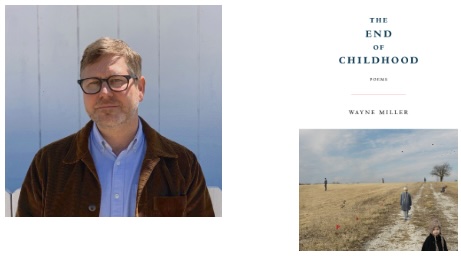
Paradox at the Heart of Poetry: An Interview with Wayne Miller on his newest book, The End of Childhood.
Poet, translator, editor, Wayne Miller is the author of six poetry collections and five other books, which he has co-translated and/or co-edited. His awards include: fellowships from the National Endowment for the Arts and the Poetry Foundation, a UNT Rilke Prize; two Colorado Book Awards; two Pushcart Prizes; and a Fulbright Scholarship to the Seamus Heaney Centre in Northern Ireland. He teaches at the University of Colorado Denver.
KW: Not that poets are ever at war with themselves when they write!—but this book seems like a rallying cry against form and narrative, when, at the same time, its very shape acts as a testament for the necessity of form. It's hard not to read the book as an attempt to create structure when the opening poem is titled, "Toward a Unified Theory," a sprawling, beautiful poem conversely made up of almost haiku-like singular "bits." Four sections follow this "unified theory," the title of each opening poem serving like a section title: "The Cold War," "On Aesthetics," On History," and "On Narrative."
At the same time that this book demands consideration of structure, beautiful momentary images float throughout it, which seem to illuminate the episodic, the simply "felt":
The self
is small patches of snow
resting on nothing—
So many poems protest the narrative: narrative supplants the past and creates a structure that "holds us." We inhabit a "system of construction," a "vast system of erasure":
"It's impossible to understand what you're born into
until enough time passes that all of it
has been replaced by narrative."
Talk about the yingy and the yangy! This conflict is such a central force in your book. Can you talk about your own impetus in writing this book? And what you discovered?
WM: First of all, thank you so much, Kathryn, for spending time with The End of Childhood and for thinking about the book in such detail. From my perspective, The End of Childhood isn't resisting form and narrative as much as it's attempting to consider how form and narrative participate in memory.
Milan Kundera says that memory isn't the opposite of forgetting, it's "a form of forgetting." That idea shapes so much of how I view human experience. Throughout The End of Childhood I'm exploring how memory is really a hodgepodge of constructed narratives that have replaced the unreachable, daily truth of the actual past. Between those constructed narratives lie vast patches of nothing. (What did I do on, say, March 11, 1987? God knows. And yet I assume I lived that day as fully as any other.)
Narrative supplanting reality happens on the level of the individual, but also on a societal level. I was a history major back in my undergraduate years, and the narratives of history that we as a society carry forward and maintain are the result of complex—and contested—systems of construction and erasure. Those systems arise from all sorts of motivations, some of which I'm horrified by.
And yet none of this is finalized—either individually or societally. Czesław Miłosz says the past isn't closed, "it receives meaning from our present actions." This idea gives me hope—even as the past we respond to in the process of building our future is, itself, a construction. For me, paradox is at the heart of poetry, and this paradox—the future trying to build real, meaningful corrections in response to a past that's always partially fiction—seems to me foundational.
I realize this answer might sound overly theoretical. But the experience of watching my young kids live through months and months they'll never remember—but that will still fundamentally shape them, and that we as parents will turn into stories for them—was a catalyst for centering all this sort of thinking in The End of Childhood.
KW: The End of Childhood is filled with wonderful metaphor, wonderful because it is not used gratuitously. I found myself googling "on the necessity of metaphor in poetry" and was bread-crumbed into the poet Edward Hirsch's "Metaphor: A Poet is A Nightingale." Hirsch calls the poem "a hand, a hook, a prayer." The metaphor that creates a "soul in action" is the instigator of a deep community between poet and reader that ultimately leads to the "sacred mysteries of poetry." So much of "The End of Childhood" is about the familial and genealogical forces that shaped us as children when "it's impossible to understand what [we're] born into." Our memories and understanding of our childhood are generational, multi-generational. It seems that in order to understand them, we must create our own narratives, through metaphor. The metaphors you give us are beautiful, mysterious: the cold war, klieg lights, the statue-less plinths, the dark center of vending machines, relic of severed tongue, the camoufleurs, to name a few. So many poets in the Colorado Poet's Center teach and I think most would say that one of the great challenges is teaching young poets how to use metaphor and why. Will you share with us your work with metaphor in this book and how you work with your own students on metaphor?
WM: Edward Hirsch was one of my professors during my MFA at the University of Houston. He was an important mentor for me, so I really appreciate you bringing him in.
When I first started writing poems, I loved metaphor for its ability to disorient or dislocate—to capture image at the semi-confused instant of apprehension. Back then I was interested in phenomenology, and I still really love a beautiful, sensory-based metaphor when I encounter one.
But over time that version of my own poetry started to feel to me a bit too ornamented. How many metaphors did I really need hanging from the branches of my poems? I became increasingly interested in how the branches themselves (or the tree!) could be metaphors, if that makes sense. I wanted my metaphors to be more integral to my poems' arguments.
So, for example, you mention the metaphor of the statueless plinth in the poem "Socialist Realism." For several years I had in my notes the idea that a white noise machine was like a statueless plinth. I even tried to write an earlier poem with that metaphor in it—but the poem never really transcended the image itself. It was only when I was thinking about my time in Albania—the statues of deposed leaders, the massive historical changes in that society—in conjunction with my children's pure, domestic, apolitical understanding of the world at their young ages that the metaphor took on additional meaning. That's when I knew it had found a home.
But from a teacher's perspective, it's always worth saying that there are a lot of different kinds of poems. When I teach metaphor, I simply try to emphasize the idea that all metaphors yoke together two fundamentally unlike things. A good metaphor should surprise the reader with the connection it makes. For me, a fresh, truly surprising connection at the heart of a metaphor is often enough to feel like it has a bit of an electric charge.
KW: So, this is maybe a little more complex of a question. You have published umpteen poetry books and won umpteen poetry awards; you've edited, co-edited, translated another umpteen; you are the editor of the widely acclaimed literary journal, Copper Nickel, and you teach at an enviable university. Someone looking in would say that you are fully ensconced in the literary world. Yet you don't seem to like it. Perhaps I'm being a tad facetious, but I've actually never read a poetry book which can so quickly flick the poor poet into that dreaded Macbethian pigeonhole of idiots and sound and fury and nothings signified. For instance, I'm thinking of the list poem, "Late Capitalism" where "The poets lived their lives/in late capitalism. They wrote their poems, bought their hybrids/in late capitalism. . .". Or of the "great writer" and his "things" of the "Canonical." Or the image of "the panel on the ethics of violence in literature" who get to "flash brightly inside/the airless cavern//of the Marriott." (Ouch! Haven't we all been there?)
But there is another dimension here, because you are complicit, too. If this realm of literature "wants the world/to be complex intensified//an entanglement of difficulty," you are equally at fault for engaging in the almost sensual pleasure of telling story— it's an "illicit pleasure," a "joy/that's barely worth saying," but it's a joy, a "a stolen sort of pleasure" that you both desire and fear/despise.
Only the image of your daughter in winter building a "path of boards across a lake" suggests a poetry, unreachable you seem to fear for yourself, that is somehow pure, somehow not blameworthy:
just
to leave a perfect
track of boards
floating on the water
that first day
the ice has melted."
One, how do you even manage to get one line of poetry down given all those internal conflicts going on?! And, two, what are you saying about poetry and the poet in this book?
WM: I both love and dislike the literary world.
I hope it should go without saying: I love literature. My old rhetoric professor J Kastely used to say that a great book "reaches inside your soul and reconfigures it forever." I love that. I've shaped much of my adult life around that very idea. And I love so many of the brilliant, talented people I've come to know who also love literature. I love the communal quality of the literary world and its many profound, ongoing conversations. There are just so many good writers today—I feel incredibly lucky that literature has found a bit of space for me inside it. I also love my role as an editor, through which I get to advocate for work I love and believe in. It's an incredible privilege. I'm grateful for all of it.
But there's also a crass, individualistic, ego-driven, self-congratulatory quality to the literary world that frustrates me. I was just at AWP, where I had a long conversation with an excellent younger poet who was explaining all the energy poets today are putting into building their "brands"—even attacking and tearing down other poets to help enhance their visibility and branding. That's just so gross to me.
Of course, none of us are pure in this world, and that certainly includes me. We all advocate for our work; we all scramble for publishers and jobs and positions. I'm often considering and assessing how I participate in the literary present, the socio-cultural present, the political present. I certainly don't have easy answers on how to do any of it with grace.
But I do know that we should default toward generosity, kindness, and humility. And I do believe that we have to love literature more than we love our own writing.
I was told by my undergraduate professor Stuart Friebert that you don't get to write about being a poet until you've published at least four books; to do otherwise "begs the question." I took that to heart. And when, in my most recent books, I started thinking in poems about this work of being a poet—work I've been doing now for almost thirty years—I quickly found myself caught up in self-assessments and self-arguments. Auden says we make poems out of the arguments we have with ourselves. One of the arguments I'm continually having with myself is about the entangled doubleness of the literary world.
KW: Poet, translator, editor, educator; twice winner of the Colorado Book Award; traveling poet of world-wide poetry readings . . .what's next?
WM: Again, thanks so much for giving The End of Childhood some attention.
Right now I'm caught up in two non-poetry projects. The first is a revised and expanded second edition of Literary Publishing in the Twenty-First Century, which Travis Kurowski, Kevin Prufer and I are working on. The first edition came out in 2016; the second will come out from Milkweed Editions in 2027.
I've also been translating a book of short prose by the Albanian writer Moikom Zeqo. I co-translated two of his poetry collections—Zodiac (Zephyr, 2015) and I Don't Believe in Ghosts (BOA, 2007). This new book—called Sellers of Chaos—collects short fiction and essays. Zeqo is such a brilliant, weird, idiosyncratic writer and thinker, and I just love spending time inside his mind and language—which I've been doing with this book for the past eight years. It will come out from Unbound Edition Press in early 2028.
Beyond that, I'm writing some new poems, though I have no idea where they're going or how they might collect. (And I've been playing around with a bit of prose—though who knows what, if anything, might come of that?)

